Over the past few weeks, I’ve felt myself develop and enhance my writing. That feeling has honestly been one of the most exciting things I’ve experienced at UNE so far. Throughout high school, I had been stuck on a plateau with my writing and critical thinking skills. However, these past classes have made me realize areas of growth and new techniques I can work on incorporating into my work to produce higher level writing.
Writing 110 has caused me to critique my definition of annotations. I now understand that it is about having a meaningful conversation with the material I am reading. It is essential to leave organized notes that are useful to reflect on when needed in the future. Now, I work to go beyond marking up the understanding, questions, and simple connections. I dive deeper into the rhetorical analysis and am getting more comfortable challenging and extending on an author’s ideas. The image below exemplifies my use of challenging what the general public says about the pros of media platforms increasing our number of friends. I strongly disagree with this and argue that our online connections are not genuine and can cause more harm than good. I want to see the evidence that proves we have an increased number of real connections through a screen. In my life, I could be “snapchatting” with someone one night and then awkwardly hurry past them the next day, avoiding eye contact. How is this a genuine friendship?

My annotations throughout the essay, “The Hawk,” were fairly strong but lacked organization. When I used the brief annotation guide to label my notes, it made it much easier to answer reading response questions later. For example, instead of just noting, “me too!” when I found a connection with Doyle’s essay, I specified my text to self connections in Maria Konnikova’s essay, “The Limits of Friendship.”

The green highlighted sentences are the ones that resonated with me regarding how the constant influence of technology will impact children throughout their youth into adulthood. I mark this text to self connection with “ER” and note that this issue directly applies to my future career in the education field. I will continuously face the challenges of teaching in a world filled with social media, artificial intelligence, and limited face to face social interactions, as Konnikova touches on in her last paragraph. Similarly, when Konnikova explained the idea that our five closest people can shift over time, I labeled a star and text to self connection too. I have seen my closest five people drift in and out of my life, especially when changing hockey teams and transferring high schools my junior year.
A huge credit to my literary and writing improvements thus far goes to “They Say I Say” by Gerlad Graff and Cathy Birkenstein. I realize that there is power in introducing someone else’s ideas to situate and strengthen my own point. My Barclay paragraph practice felt like a strong start to using multiple source integrations in one paragraph and then stating my point afterwards.

The underlined phrase shows my use of a signal phrase followed by green highlighting of paraphrasing and partial quoting of experiment findings. I then connect this back to my claim through the yellow highlighting and am about to pull my personal experience into the next paragraph. Additionally, in our group paragraph from class, I brought in a template phrase from “They Say, I Say.” Stating the template phrase, “this is not to say that…” helped reinforce and conclude our argument that meaningful connections can only be maintained through face to face interactions. When I am reading essays, such as “Shitty First Drafts” by Anne Lamott, I notice the writers use the approach of addressing public opinions, or the “they say,” and then bring in their own voice. Lamott cleverly uses a run-on sentence to explain the misconceptions we have about famous authors. I note this rhetorical choice and its effectiveness, noticing this thanks to having read “They Say, I Say.”
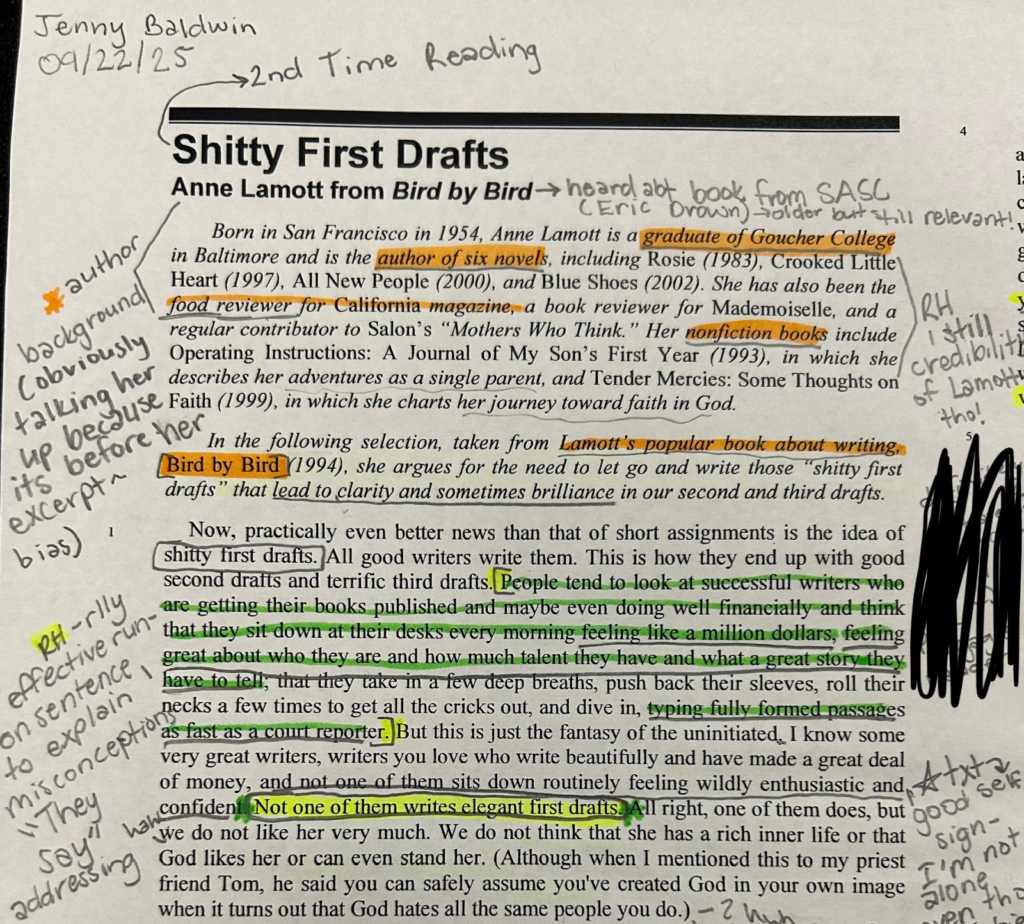
This image also covers the importance of previewing a text to have an understanding before diving into it. Before Lamott’s opinion on first drafts is introduced, the reader gets a background on her. This not only provides credibility to an author but helps us understand potential bias and their beliefs. Taking five minutes to do a quick background check on an author has helped me settle into what I’m reading and further appreciate their work.
I have possessed some of these writing skills at a basic level but can already see my growth in understanding and application so far. These new skills have spilled over into my other courses. In my Women of the West literature class, I was able to analyze the specificity of an author’s violent verb usage in her poem. Also, in my First Year Seminar class, I have been able to comfortably express my personal experience to strengthen my writing. I have felt more confident in joining the larger conversations here at UNE that require thoughtful critical thinking. I am grateful for the “They Say, I Say” resource, the techniques I have learned in this class, and the essays I have read and will write going forward. I am ready to take the bull by the horns and become a more eloquent writer.