I am grateful the peer review process has become more extensive in college. In high school, we would exchange papers for about 15 minutes. The reader would leave a few minimal comments on spelling and grammar and the occasional “good job.” This never really helped me as I could spot most of the grammatical errors and correct them myself after proof reading. College has taken this process to the next level, where global revision is focused on and I’m not afraid to give a peer more detailed feedback. I also get more constructive criticism that informs me on what the reader needs more of. I don’t feel rushed nor stressed because I have a full class to sit with my peer’s work and give them thoughtful feedback.
My question here gives the writer an idea on how to connect themselves into the paragraph and make it a more engaging and effective Barclay paragraph. As the reader, I can feel that there is some disconnect between the sources and the writer’s own voice. Hopefully, my comment gave them insight on ways to expand their thinking.
Comment on Peer’s Barclay Paragraph
End Comment on Peer’s Joy Essay
Above is my end comment on another peer’s work commends the specificity of some of their personal examples that really captured my attention. I leave insightful feedback on improving and adding source integration. As I read through my peers’ drafts, I find new strategies on how others incorporate ideas and support their theses. I also remember all the things I need to include in my essay which I may have forgotten, like naysayers and integrating more sources. I really enjoy this in depth peer review process we have used in WRT 110 because it’s helped me revise my essays to become as strong as possible.
Receiving constructive criticism from a peer always brings my attention to where my essay needs the most work. These two comments below made me realize that I spent too much time summarizing a story and hardly related it back to its bigger purpose in my essay.
Peer Review Feedback on Interview Body Paragraph
I was able to take this feedback into my revision process where I cut down on summary and brought more of my own voice in. I really appreciated receiving these insightful comments because they helped even my “They Say,” “I Say” proportions and gave meaning to the special stories my grandfather shared when I interviewed him. This paragraph transformation is shown in my revision learning outcome tab!
When revisiting my first reading response to “The Hawk,” I immediately saw places where I could’ve dove deeper to strengthen my connections. The question asked which themes and ideas resonated most with you from the story. I gave a lengthy response but the highlighted lines signal where I would now critique and add more specific “I say.”
First Reading Response Paragraph to “The Hawk”
When I talked about my respect for the Hawk taking time for himself by camping out at the football field, I could’ve added how I’ve been through my own mental health struggles. Taking the time to step back and ground myself, whether that be through hockey or hiking, has been extremely beneficial for me and I can value and understand the Hawk’s reasoning behind returning to the football field. That is his home and place of comfort, as the ice rink and White Mountains can be for myself. As I was reviewing this first reading response, I noticed these highlighted places where I could’ve gone deeper and given a better explanation of why these themes resonated with me. This shows my improvement in incorporating the I say component and I’ve been much more confident in doing so lately. Making these text to text connections has become a more natural part of my annotating and writing in my recent reading responses.
Strong annotations, including text to text connections, helped me respond to reading questions that further helped me craft my final essays. When annotating in high school, I mostly only made understanding marks to define a word, jotted down questions, made shallow connections, or highlighted important phrases. Over the semester, I have been able to challenge the author or extend on their ideas while observing their rhetorical choices through these new annotation strategies. Many notes fill the margins of my class handouts in a somewhat organized way, thanks to the symbols we’ve used. The attached image shows my continuation of leaving notes to help my understanding when flipping back through Bloom’s essay, “Is Empathy Overrated?” while I also make a deep text to self connection. When my brother passed away, people sent hundreds and hundreds of flowers to us as an act of empathy, but like the town of Newton, the money spent could’ve been put towards those who actually needed it. I also acknowledge Bloom’s effectiveness with the Newton massacre example, where he builds up his argument on empathy’s dangers through this paragraph and the two previous ones.
Understanding, Exploring Relationships, & Rhetorical Annotations from “Is Empathy Overrated?”
The text to text connection I made in Bloom’s essay carried into my reading response, which then arguably became my most valuable personal example in my empathy essay. My ability to challenge an author through annotations is shown in this image where I push back on Bloom’s claim that empathy impacts us in the same way that prejudice does. This sharply contrasts with my own beliefs, which I noted. I also observed Bloom’s clever rhetorical move to welcome his audience with a gentler first paragraph before dropping this controversial view.
Challenging & Rhetorical Annotations from “Is Empathy Overrated?”
These annotation strategies have helped me gain a deeper understanding of the source material while encouraging myself to think more critically and push back on an author’s ideas. In the end, many of my annotations and reading response topics are expanded on throughout my essays.
Over the course of the semester, I have become more confident when integrating sources and voice into my essays. I have learned to use the Barclay paragraph style to create a flow between two outside sources and a response with my own ideas and interpretation. The paragraph below comes from the rough draft of my empathy essay. I do a nice job with the first part of the quote sandwich where I acknowledge Maria Konnikova and her credibility. However, the highlighted section is where a reader got confused with the relevance of Konnikova. There was a disconnect between her quote and my bigger argument, which is focusing on unbiased kindness over empathy.
Body Paragraph from Rough Draft Empathy Essay
As seen in my revised paragraph below, the increased amount of my own voice draws the connection between Konnikova, Bloom, and my thesis. In its final draft, the triangle of voices in this paragraph brings purpose to my essay in an effective way, thanks to the well crafted Barclay paragraph. I start off by giving the reader more context when I define pathetic empathy in my second sentence. Then, I delve into Konnikova’s point that communication through social media lacks the synchronicity of a shared experience. However, I don’t hit and run with this quote because I analyze it and draw the bigger connections for the reader by explaining it as highlighted. This leads into the bold section where the sentences naturally connect to my next source, Paul Bloom. His insight aligns with my thesis that there are better alternatives to empathy which is falsely occurring online.
Over the semester, I have improved my ability to effectively introduce sources, quote them, and then explain their purpose through implementing Barclay paragraphs.
My revision process has seen tremendous improvement since high school. The major focus of feedback was on the grammatical errors and punctuation in my earlier education. However, Writing 110 has helped me shift from this local revision to the more important global revision. When revising on the global level, my writing becomes more organized, cohesive, and my thesis is supported throughout the piece. Below, I have inserted a paragraph from my rough draft joy essay.
Body Paragraph from Joy Essay Rough Draft
The paragraph has far too much summary and fails to answer the reader’s demanding question, “so what, why does this matter?” This class has taught me that I can always edit my ideas and evaluate their effectiveness. Once something is on the paper, it doesn’t have to stay. As seen in the following image, I eliminate some of my rambling summary of my grandfather’s stories. I address the readers’ needs by bringing more of my voice into the paragraph, which further ties the insightful stories back to my thesis of feeling joy through our senses and embracing the small moments. Though this paragraph may not be at its final version, it has progressed towards a more balanced amount of “they say” or my grandfather’s voice, and my own “I say,” as I’ve highlighted. Diving deeper into my own analysis has given my paragraph more purpose and nicely acknowledged the importance of my grandpa’s valuable stories.
Improved Body Paragraph w/ My Voice from Joy Essay
Writing 110 has helped me use peer review comments and my own expanded knowledge to hone in on critiquing my essay’s organization, cohesion between thesis and provided evidence, and the balancing of voices. Then, I can go back to my high school focus of nitpicking the grammar, word choice, spelling, and punctuation to put the bow on top of my essay before gifting it to my audience. I address these local revisions in my revised paragraph as well as the larger scale issues I prioritized during the global revision step, which has advanced my revision process to the next level.
As a society, we focus on the cliche of “putting yourself in someone else’s shoes” or empathy, when we should be putting our energy into kindness instead because kindness motivates unbiased action. When we first critiqued my thesis statement in class, I felt that it was a run-on sentence and the ending was repetitive. Once I let it sit and reread it, I realized that it’s setup is similar to a “if, then” hypothesis statement by saying we do this but really should be doing this instead. This way of setting it up clearly shows my viewpoint and stance. I feel that it is specific and has strong word choices that resonate with the audience. They can pick out the key terms of cliche, energy into kindness, and unbiased action. The word motivates has a strong and positive connotation that sits really nicely at the end of my thesis and introduction paragraph. With the given sources for this essay, my claim had plenty of places to pull from Bloom’s arguments. It was a little harder to dig into the weeds to find a connection with Wallace and Konnikova though. Overall, I felt that my thesis was strong and liked the repetition of kindness because the reader knew where I was headed with my paper. I’m glad I moved its placement to the end of the introduction because it helped my essay flow a lot better.
During this essay, I was reminded that I often have a hard time getting my initial thoughts on the paper. I hate that I am a procrastinator and tend to struggle with it most when it comes to writing. Ironic that I want to be an English teacher, right? I was also reminded of the importance of sharing my work before submitting it to get more perspectives. A professor in one of my literature classes today claimed, “It’s hard to write in isolation.” This resonated with me and was another reinforcement of leaning on others through peer review to not only improve my essay, but my enjoyment of the writing process as well. Receiving constructive criticism always helps me step back from my own clouded brain and see how my reader is feeling. I learned that switching sentences around can enhance a smoother flow throughout my arguments. Balancing the “they say, I say” portions of my paper is something I need to continue to look out for in the future. Lastly, I remembered how effective the reading to the wall method is in fine tuning my final essay.
In my essay “The Power of Impartial Kindness,” I focussed on global revision more than I have in any other piece of writing. My three main priorities were making my evidence connect to my thesis, increasing specificity, and incorporating more of the source voices into my essay. I tried to focus on asking myself what I was arguing and how to make it more interesting. Giving more details on my most important text to self connection about my brother’s passing and the unnecessary “empathy” my family received strengthened its purpose in my essay. The remainder of my revision process revolved around finding the best parts of DFW’s speech to incorporate into my essay and adjusting where ideas fit best to prove my thesis.
I will address our next essay differently by trying to have more completed before the peer review process. I was happy that I had my rough draft down on paper, but enjoy getting feedback that pushes me closer to my final draft. I will make sure to continue taking my time to understand and annotate the sources we get in class. Lastly, I will try to time my essay better because there was a gap between receiving my peer review feedback and implementing it into my essay. Better timing will allow me to remember changes I want to make and strengthen my overall writing process.
Throughout David Foster Wallace’s commencement speech, he clearly argues three main points. His introduction begins with a brief story about a fish swimming past two others, asking “How’s the water?” (Wallace). A few minutes later, one fish asks his friend, “What the hell is water?” This sets up Wallace’s message to Kenyon College’s graduating class of 2005 on the importance of awareness. He brings up the mundane day to day interactions and processes graduates are bound to go through. These tedious tasks include having to go through a long stressful day of work, followed by annoying traffic, and then the negative environment of a packed and poorly lit grocery store. This is followed by the explanation of the default setting. It is easy for us to constantly pick out the negatives in people and our experiences when the frustrating components of adult life surface. Wallace argues that having a pessimistic view is “so easy and automatic” and “frustrating crap like this is exactly where the work of choosing is gonna come in.” Having awareness allows us to crack the default setting and think deeper about the things that are annoying us.
Since Wallace is addressing soon to be college grads, he incorporates the liberal arts education cliche that college is where students are learning how to think. He challenges this motto, claiming that university actually teaches us not how to think, but instead, that we have the choice of what to think about. Wallace puts into perspective that we don’t have to despise the checkout lady who says, “‘Have a nice day’ in a voice that is the absolute voice of death.” Nor do we need to get lost in the list of small annoyances and hating life because of them. We can break this default setting if we push ourselves to think, maybe the man who just cut me off on the freeway has it worse than I do. Perhaps, I’m the one in his way. He could be rushing his sick child to the hospital. We can use another cliche and put ourselves in others shoes to make ourselves a little less miserable when possible. Not every day do we feel like putting in the effort, but it’s usually beneficial when we can look further than our default settings. We have the power to decide how we want to see things in this world. Wallace’s opinions come off very strong through his harsh words and I was a bit turned off at first. I think he offers valid points but dislike this piece as a commencement speech. I feel that the message of the power behind choosing our thoughts is important but dislike the way it’s done. His personal experiences that the audience can universally relate to are portrayed in a very pessimistic light. The suicide example felt too heavy for a moment I feel is supposed to be geared towards a balance of preparation, celebration, and inspiration.
I agree with Wallace’s main points I discussed above, yet I do not like the way he argues them. Yes, I feel that college is a combination of teaching us how to think for ourselves and that we have the choice and freedom of our thoughts. I also agree that it’s important to try to feel for others when we can. When we consider others and their lives, we are looking at a broader picture that helps us understand why people act the way they do. In the long run, we benefit from being less pessimistic and bothered by the annoyances that pile up throughout adulthood. It is essential to be aware of what I call autopilot and Wallace calls the default setting. We need to be careful and draw ourselves back through awareness when we see that we are just going through the motions and judging others. Wallace has evidence to back up these points but I strongly dislike his examples. More often than not, his word choice rubs me the wrong way and angers me. We all have bad days of course, but to voice to young graduating adults thoughts of “the ugliest, most inconsiderate and aggressive drivers” or “how stupid and cow-like and dead-eyed and nonhuman” people seem at the end of long days is extremely rude. Additionally, his other point that we are the center of our worlds and every experience is an understandable argument but I can’t fully wrap my head around it. The way he explains this idea does not track with how I view myself as a person. It feels too selfish when I am almost always thinking of others before myself.
I don’t believe Wallace is referring to empathy. I can’t place my finger on a term, but he’s getting at something different. I believe that empathy is the ability to feel for others because we want to and have “moral good” within us. Empathy is something we naturally do. On the other hand, Wallace is saying that we should think twice about other people for our own benefit. This feels a little backhanded and reminds me of when people will apologize because they want to feel better about their wrongs and the uncomfortable situation. Their secondary focus is the fact that they feel bad and are owning up to their poor actions.
“And look at how repulsive most of them are, and how stupid and cow-like and dead-eyed and nonhuman they seem in the checkout line…”
This quote simply pissed me off. Commencement speeches are given to students who have just successfully completed college. They should warn students of the challenges of the outside world and the mundane day to day tasks but they should ultimately be a congratulations with positive words of wisdom for the future. Wallace is being very rude and putting this image into young adults’ heads. I know this isn’t his motive and we all have these thoughts from time to time, but who is he to bring this up and judge others? He’s speaking of doing the opposite and being mindful, yet keeps listing more and more situations through vulgar language. I’d like to have challenged Wallace to make this argument without these harsh examples because he offers valid points.
Wallace and Bloom’s points interact together interestingly. These pieces both get at the importance of thinking of others. While Wallace focuses on the ways that looking deeper into others’ lives is beneficial to increase our awareness, Bloom argues that empathy is dangerously biased and negative. “This is Water” explains why we need to focus on the little things that are forgotten about. These small things contribute to why we hate or love our lives through the default setting. Bloom is pretty much arguing the opposite. He explains that far too often, we care for others on a small scale and empathize with those who are similar to ourselves. This bias gets in the way of those who really need help and are struggling on a much larger scale. At the end of the day, Wallace really only cares about himself being the center of everything. To be the best version of himself and not so miserable from day to day life, he makes up scenarios to try to feel for others. This is really just his way of escaping the consequences of self centeredness and the default setting. Bloom argues that empathy compares to prejudice in the way that we bias who we care for. His point is that our energy is too often put into the wrong places so we should focus on rationality and kindness instead.
1. Paul Bloom’s essay, “Is empathy overrated?” brings his unique perspective on empathy to the reader’s attention. Bloom uses a clever craft to invite the reader to the conversation on empathy before disclosing his controversial opinion. He uses the analogy of empathy being like a spotlight to portray his first belief that the trait is narrowly focused (Bloom 1). Throughout each paragraph, a strong topic sentence has a subclaim backed by evidence and specific examples to prove that empathy does more harm than good.
I believe Bloom’s three main points fall under the spotlight idea of empathy and its limitations and misuse. The argument that “empathy reflects our biases” and only “focuses on specific individuals” drives home the single mindedness we unintentionally have (Bloom 2). This is dangerous because Bloom gives the example of the Sandy Hook Elementary School shooting. Larger scale shootings and other tragedies happen on a more regular basis in places like Chicago. Newton and other surrounding towns dropped everything to send millions of unneeded toys to the impacted families. Paul himself admits that he has an easier time empathizing with the families of Newton over those of Chicago and the thousands of people killed and affected by homicides. This is because of his bias of being a white man who lives in Connecticut and is a father. This idea is further backed by the point that we can empathize with one person whose story we know, rather than the statistics of a large scale of people struggling. The pathos evoked from the image of “an adorable eight-year-old” that’s critically ill clouds our mind from grasping the bigger picture. Just because a vaccine has sickened this one girl, doesn’t mean it’s not having a tremendous impact on twelve other children and saving their lives. In other words, Bloom is saying that we know it’s better for one child to die than twelve, yet we cannot feel this way when twelve is only a statistic and on the other hand, we feel the hardship of the young girl and her family. In this way, “empathy is insensitive to consequences that apply statistically rather than to specific individuals” (Bloom 3). Lastly, Bloom argues that “what really matters for kindness may be self-control, intelligence and a more diffuse compassion” (Bloom 3). Rather than focus on empathy, which has its many downfalls, we should focus on kindness. That way, we take control over the natural biases we have, and can realize what people really need in a time of hardship. We can focus on the statistics of the biggest issues that need solving so that we don’t get caught up in the smaller ones. We can spread our compassion to the places it is needed most by being smart and unbiased. All in all, Paul Bloom argues that there is a better solution to improving humanity than being empathetic.
2. I agree with the main argument that we have a natural bias that impacts who and how we empathize with certain groups of people. It is easier for me to feel for my Mom in a situation than a stranger from another country. Bloom has a good point about the spotlight that empathy places on people and how it leaves behind others who may need the help more. This essay made me really think about the effectiveness of our empathy. When my brother passed away in 2018, all of our friends, family, and even strangers came together to show their support and love. It was a beautiful way to celebrate my brother’s short lived but amazing life. However, similar to the millions of unneeded toys sent to Newton, Connecticut, hundreds of flowers filled our house, covering every space possible. People probably spent thousands of dollars on these. Yet, my family and I didn’t even like flowers. Nor did my brother. This empathetic act came from a place of care but was not what my family and I needed. This money could have been put to a needed cause, like hunger or mental health resources to decrease the American homicide rate. I think that focusing on kindness through self-control, intelligence, and a broader compassion could be more effective than empathy itself, as Bloom claims (3).
3. Bloom challenged my initial understanding of empathy because I had never really viewed it as a bad thing. Yes, I knew it could be harmful to be overempathetic because people could take advantage of you or the receiver could feel inept. However, I always thought that it was a really good thing. It is important to be able to put yourself in others’ shoes and feel for their situation. Everyone always carries something. I felt that it was essential to try to understand this and lend a helping hand to those who needed it. Bloom completely challenged my initial ideas because his entire argument revolved around the fact that empathy’s “negatives outweigh its positives” (Bloom 4). When I first read his argument that empathy is pretty much the same as prejudice, I thought to myself “hell no.” Throughout reading his essay though, I came to understand his general opinion. I saw the evidence that suggests we should put our energy into a better alternative that is more encompassing than the characteristic of empathy.
4. “Empathy distorts our moral judgments in pretty much the same way that prejudice does.”
This is the one claim that I strongly disagree with from Bloom. I understand the limitations of having bias and how that impacts who we care for the most. However, I think it’s natural to feel stronger for someone similar to us. This does not necessarily mean that we are throwing prejudice on another person who is struggling though! This argument rattled me at first. I can see Bloom’s point that he’s getting at, but stating that empathy is almost equivalent to prejudice goes too far for me. Prejudice raises the red flags of racism, sexism, and homophobia. I may be naturally inclined to help someone similar to myself, but this does not mean I am kicking others’ problems to the curb by prejudicing them.
5. In Bloom’s last paragraph, he regards empathy, concluding that “its negatives outweigh its positives – and… there are better alternatives” (Bloom 4). Do you agree with this? Where are the “better” places we should be putting our energy into? Is it possible to transform the negative definition of empathy we have made and turn it into a positive thing?
Over the past few weeks, I’ve felt myself develop and enhance my writing. That feeling has honestly been one of the most exciting things I’ve experienced at UNE so far. Throughout high school, I had been stuck on a plateau with my writing and critical thinking skills. However, these past classes have made me realize areas of growth and new techniques I can work on incorporating into my work to produce higher level writing.
Writing 110 has caused me to critique my definition of annotations. I now understand that it is about having a meaningful conversation with the material I am reading. It is essential to leave organized notes that are useful to reflect on when needed in the future. Now, I work to go beyond marking up the understanding, questions, and simple connections. I dive deeper into the rhetorical analysis and am getting more comfortable challenging and extending on an author’s ideas. The image below exemplifies my use of challenging what the general public says about the pros of media platforms increasing our number of friends. I strongly disagree with this and argue that our online connections are not genuine and can cause more harm than good. I want to see the evidence that proves we have an increased number of real connections through a screen. In my life, I could be “snapchatting” with someone one night and then awkwardly hurry past them the next day, avoiding eye contact. How is this a genuine friendship?
My annotations throughout the essay, “The Hawk,” were fairly strong but lacked organization. When I used the brief annotation guide to label my notes, it made it much easier to answer reading response questions later. For example, instead of just noting, “me too!” when I found a connection with Doyle’s essay, I specified my text to self connections in Maria Konnikova’s essay, “The Limits of Friendship.”
The green highlighted sentences are the ones that resonated with me regarding how the constant influence of technology will impact children throughout their youth into adulthood. I mark this text to self connection with “ER” and note that this issue directly applies to my future career in the education field. I will continuously face the challenges of teaching in a world filled with social media, artificial intelligence, and limited face to face social interactions, as Konnikova touches on in her last paragraph. Similarly, when Konnikova explained the idea that our five closest people can shift over time, I labeled a star and text to self connection too. I have seen my closest five people drift in and out of my life, especially when changing hockey teams and transferring high schools my junior year.
A huge credit to my literary and writing improvements thus far goes to “They Say I Say” by Gerlad Graff and Cathy Birkenstein. I realize that there is power in introducing someone else’s ideas to situate and strengthen my own point. My Barclay paragraph practice felt like a strong start to using multiple source integrations in one paragraph and then stating my point afterwards.
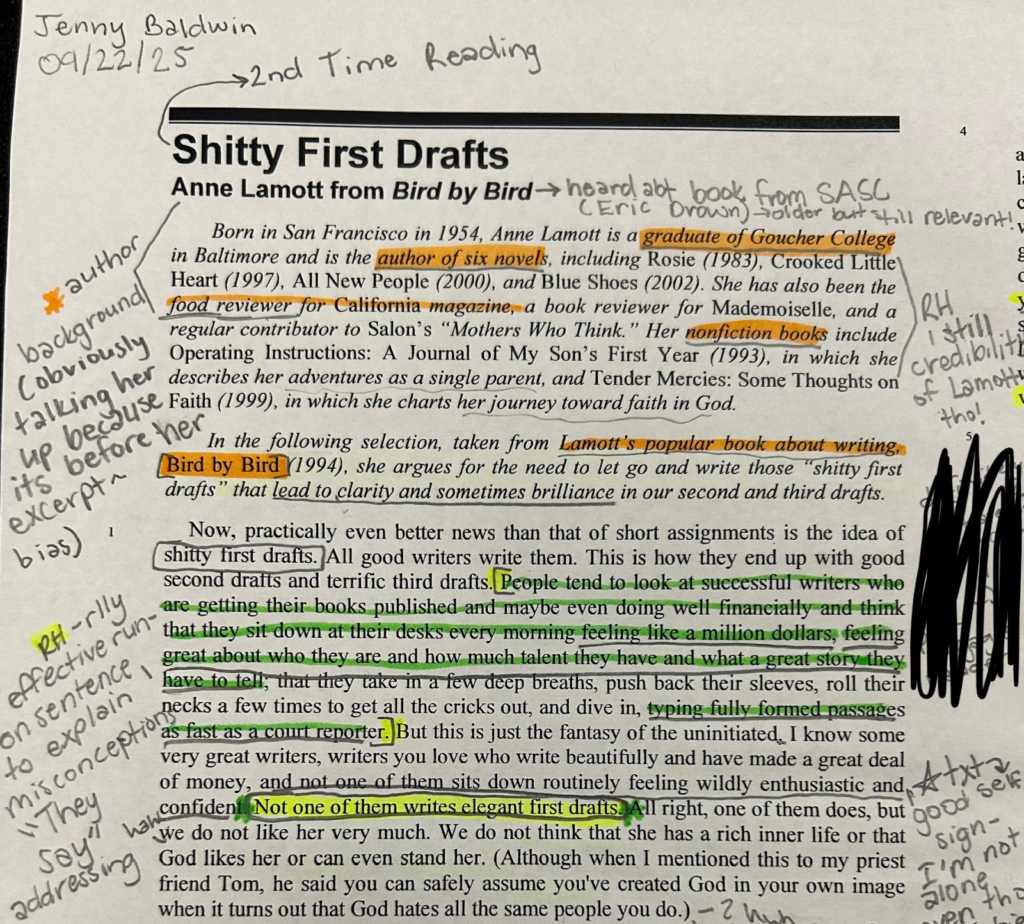
The underlined phrase shows my use of a signal phrase followed by green highlighting of paraphrasing and partial quoting of experiment findings. I then connect this back to my claim through the yellow highlighting and am about to pull my personal experience into the next paragraph. Additionally, in our group paragraph from class, I brought in a template phrase from “They Say, I Say.” Stating the template phrase, “this is not to say that…” helped reinforce and conclude our argument that meaningful connections can only be maintained through face to face interactions. When I am reading essays, such as “Shitty First Drafts” by Anne Lamott, I notice the writers use the approach of addressing public opinions, or the “they say,” and then bring in their own voice. Lamott cleverly uses a run-on sentence to explain the misconceptions we have about famous authors. I note this rhetorical choice and its effectiveness, noticing this thanks to having read “They Say, I Say.”
This image also covers the importance of previewing a text to have an understanding before diving into it. Before Lamott’s opinion on first drafts is introduced, the reader gets a background on her. This not only provides credibility to an author but helps us understand potential bias and their beliefs. Taking five minutes to do a quick background check on an author has helped me settle into what I’m reading and further appreciate their work.
I have possessed some of these writing skills at a basic level but can already see my growth in understanding and application so far. These new skills have spilled over into my other courses. In my Women of the West literature class, I was able to analyze the specificity of an author’s violent verb usage in her poem. Also, in my First Year Seminar class, I have been able to comfortably express my personal experience to strengthen my writing. I have felt more confident in joining the larger conversations here at UNE that require thoughtful critical thinking. I am grateful for the “They Say, I Say” resource, the techniques I have learned in this class, and the essays I have read and will write going forward. I am ready to take the bull by the horns and become a more eloquent writer.